





What is a Baker Cyst?
A Baker cyst, also known as a popliteal cyst, is a fluid-filled sac that forms a lump behind the knee. It is named after Dr. William Morrant Baker, who first described the condition in the 19th century.
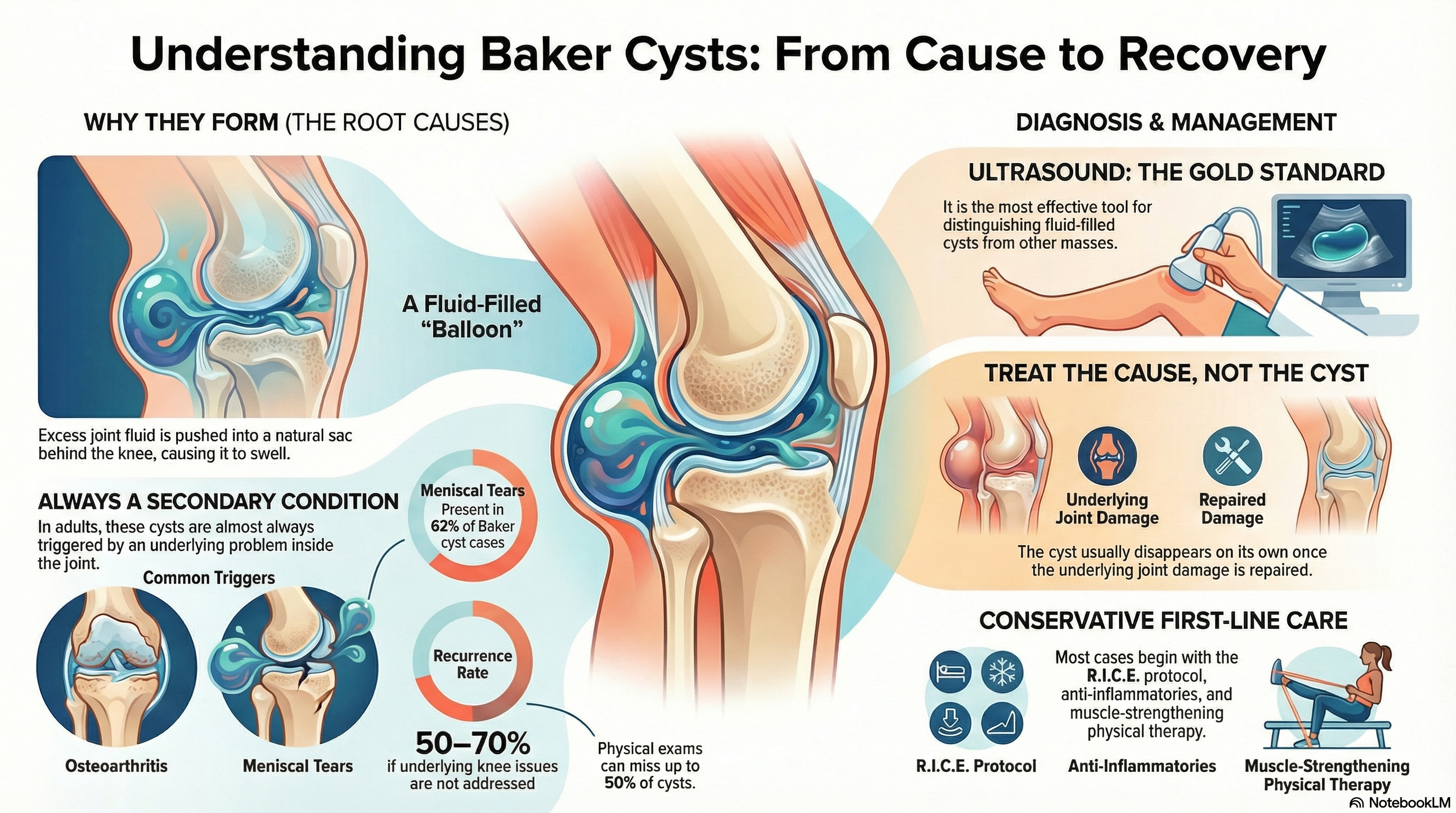
Essentially, this cyst is a distension of a natural sac called the gastrocnemio-semimembranosus bursa. Your knee produces synovial fluid to lubricate the joint. When your knee overproduces this fluid—usually due to an injury or inflammation—the excess fluid is pushed into this bursa through a one-way, valve-like opening at the back of the knee. This causes the bursa to balloon outward, creating the characteristic lump. It is important to remember that a Baker cyst is not a tumor; it is simply a collection of joint fluid.
Causes of a Baker Cyst
In adults, a Baker cyst is almost always a "secondary" condition, meaning it is caused by an underlying problem inside the knee joint. Common triggers that cause the excess fluid production include:
-
Meniscal Tears: Specifically, tears in the posterior horn of the medial meniscus (found in about 62% of cases).
-
Osteoarthritis: Wear and tear of the knee cartilage is the most common cause in older adults.
-
Inflammatory Arthritis: Conditions such as rheumatoid arthritis, gout, or pseudogout.
-
Knee Injuries: Cartilage damage, ACL tears, or loose fragments within the joint.
In children, the condition is much rarer and often "primary," meaning it occurs without any underlying joint damage. These usually resolve on their own without medical intervention.
Symptoms of a Baker Cyst
Many people with a Baker cyst have no symptoms at all, and the cyst may only be found during an imaging scan for another issue. When symptoms do appear, they typically include:
-
A Visible Bulge: A lump behind the knee that is most noticeable when you are standing or when your knee is fully straightened.
-
Fullness or Tightness: A feeling of pressure in the back of the knee.
-
Pain and Stiffness: Discomfort that usually worsens with activity or when bending and straightening the knee fully.
-
Serious Warning Signs: If you experience sudden, sharp pain behind the knee followed by rapid swelling, redness, or warmth in your calf, seek medical attention immediately. This could indicate the cyst has ruptured, causing fluid to leak into the calf (mimicking a blood clot/DVT).
Diagnosis of a Baker Cyst
Physical examinations can miss up to 50% of these cysts, so doctors rely on specific diagnostic tools:
-
Clinical Exam: The doctor will look for swelling and check Foucher’s sign—if the lump becomes hard when the knee is straight and soft when the knee is bent.
-
Ultrasound: This is considered the "gold standard" for initial diagnosis. It is quick, non-invasive, and can clearly distinguish a fluid-filled cyst from other masses.
-
MRI: While an ultrasound confirms the cyst, an MRI is superior for identifying the underlying cause, such as a hidden meniscal tear or arthritis.
-
X-ray: Used primarily to rule out other issues like loose bone fragments or to assess the degree of joint arthritis.
Treatment of a Baker Cyst
The most important rule for treating a Baker cyst is to treat the underlying cause. If the knee joint issue is fixed, the cyst usually disappears on its own.
Conservative Management (First-Line)
-
R.I.C.E. Protocol: Rest, Ice, Compression, and Elevation to manage swelling.
-
Medications: Over-the-counter NSAIDs (like ibuprofen or naproxen) to reduce pain and inflammation.
-
Aspiration and Injections: A doctor may use a needle to drain the fluid (aspiration) and inject a corticosteroid to reduce swelling. However, the recurrence rate is high (50–70%) if the primary knee problem is not addressed.
-
Physical Therapy: Exercises to improve range of motion and strengthen the muscles (like the quadriceps) surrounding the knee.
Surgical Options Surgery is rarely performed on the cyst itself. Instead, arthroscopic surgery is used to repair the underlying meniscal tear or joint damage. Direct surgical removal (excision) of the cyst is a last resort reserved only for cases that do not respond to any other treatment.
Prevention of a Baker Cyst
Because most Baker cysts in adults result from chronic knee conditions, prevention focuses on maintaining overall joint health:
-
Weight Management: Reducing excess body weight decreases the constant mechanical stress on your knee joints, slowing the progression of arthritis.
-
Joint Protection: Avoid repetitive deep knee bends or heavy loading if you have a history of knee pain.
-
Strengthening: Keeping the muscles around your knee strong helps stabilize the joint and prevents the minor injuries that lead to fluid overproduction.
-
Early Intervention: Addressing minor knee pain or injury early can prevent the chronic inflammation that eventually leads to a cyst.