

The American primary care system has been operating at a breaking point for years. Administrative overload, shrinking visit times, rising burnout, and financial instability have pushed many physicians to reconsider how and for whom they practice medicine. Against this backdrop, the One Big Beautiful Bill Act (OBBBA) represents one of the most consequential legislative shifts in primary care in decades.
Effective January 1, 2026, this law fundamentally changes how Direct Primary Care (DPC) and concierge practices can be paid for, marketed, and scaled. More importantly, it repositions membership-based care from a niche alternative into a tax-advantaged, mainstream healthcare strategy.
This article breaks down what the law changes, why it matters, and how physicians can strategically respond.
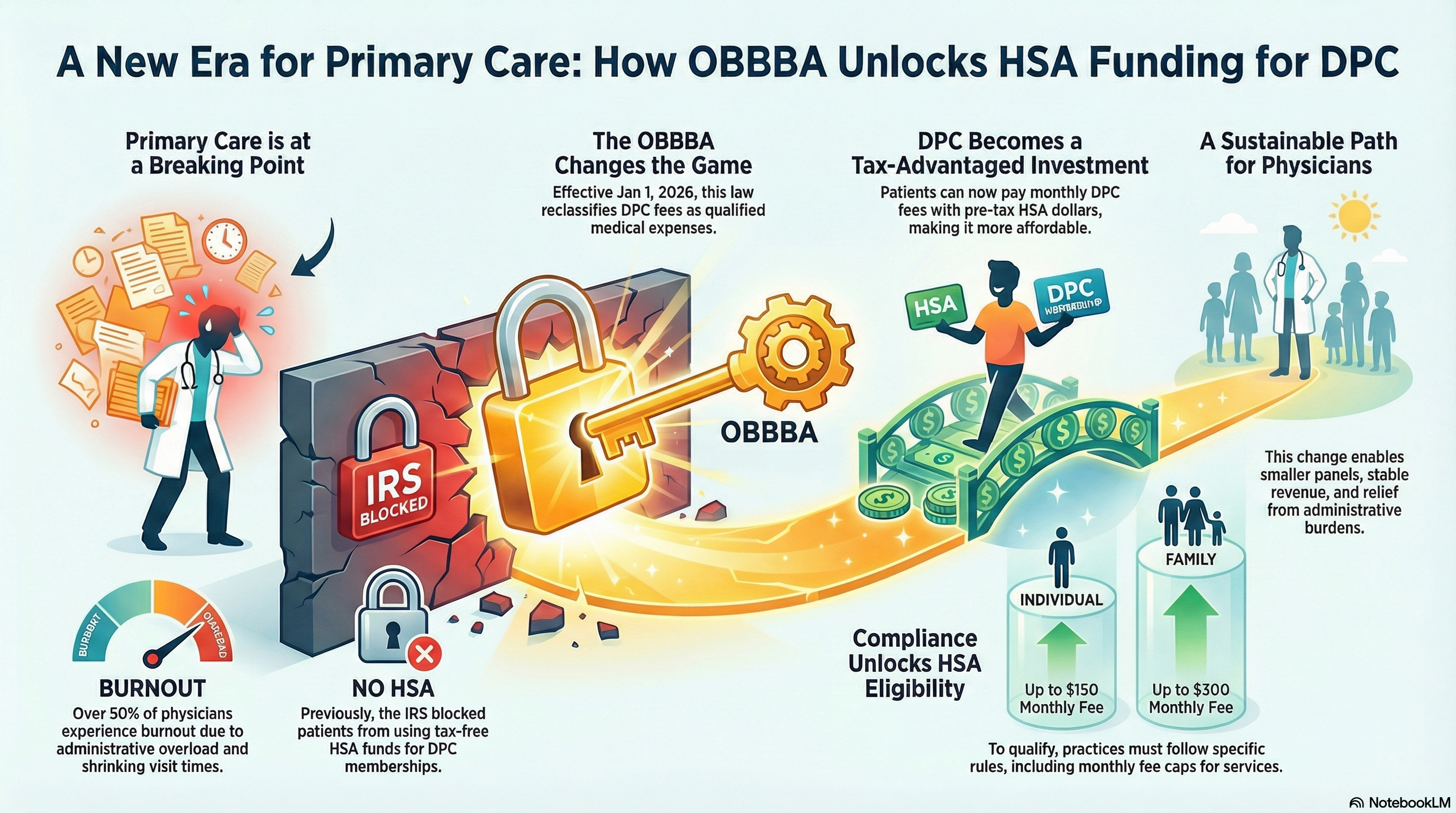
Traditional fee-for-service primary care has long prioritized volume over value. Physicians routinely manage patient panels in the thousands, while appointment times shrink to 10–15 minutes. At the same time, administrative tasks, before authorizations, coding, documentation, and EHR management, consume nearly half of the clinical workday.
The result is not merely dissatisfaction, but systemic failure. Burnout rates exceeding 50 percent, increasing early retirements, reduced clinical hours, and worsening access for patients are now well-documented consequences. These pressures are not solvable through incremental workflow tweaks. They require structural change in how primary care is financed and delivered.
Signed into law in July 2025 as Public Law 119-21, the One Big Beautiful Bill Act is a sweeping budget reconciliation package spanning over 1,000 pages. While it touches multiple policy domains, its healthcare provisions are particularly transformative for membership-based medicine.
Buried within the legislation is Section 110205, a provision that directly resolves the largest financial barrier facing Direct Primary Care for more than a decade: incompatibility with Health Savings Accounts (HSAs).
This single change reshapes patient demand, practice economics, and long-term sustainability for DPC and concierge models.
Although often grouped together, DPC and concierge medicine are structurally different models, and the OBBBA treats them very differently.
Direct Primary Care operates entirely outside insurance. Patients pay a flat monthly fee, typically between $50 and $150, for comprehensive primary care services with no copays or deductibles. The model emphasizes access, continuity, and affordability.
Concierge medicine, by contrast, usually layers a higher annual retainer on top of traditional insurance billing. Patients still face copays and deductibles, and retainers can range from a few thousand dollars to over $25,000 annually.
The OBBBA is explicitly designed around the DPC model, making this distinction critical for strategic planning.
Historically, the IRS classified DPC memberships as a form of “health plan,” which disqualified patients from contributing to or using HSAs. This single interpretation blocked millions of HSA-holding patients from adopting DPC, regardless of clinical appeal.
Section 110205 corrects this.
Under the new law:
A Direct Primary Care arrangement is no longer treated as a health plan
DPC membership fees are now classified as qualified medical expenses
Patients can use pre-tax HSA funds to pay their monthly DPC fees
This change takes effect for months beginning after December 31, 2025.
In practical terms, DPC moves from being an out-of-pocket luxury to a tax-advantaged healthcare investment.
The law is generous but precise. To remain HSA-eligible, DPC practices must comply with several guardrails.
Monthly fee caps are explicit:
Up to $150 per month for individual memberships
Up to $300 per month for family memberships
Covered services must remain squarely within primary care. Membership fees cannot include:
Procedures requiring general anesthesia
Most prescription drugs (vaccines are allowed)
Laboratory services are not typically provided in ambulatory primary care settings.
These constraints ensure DPC does not function as a substitute insurance product, preserving its regulatory clarity and tax eligibility.
The OBBBA does more than authorize HSA payments for DPC. It also expands the HSA ecosystem itself in ways that directly amplify DPC adoption.
The law allows HSA eligibility for Bronze and Catastrophic insurance plans, enabling a powerful pairing: low-premium catastrophic coverage combined with comprehensive DPC care. It also permanently allows pre-deductible telehealth coverage, an area where DPC already excels.
When combined with rising HSA contribution limits, this framework makes DPC not just clinically attractive, but financially optimized for a growing segment of the population.
For Direct Primary Care physicians, the implications are immediate and profound.
The single biggest barrier to patient adoption is the perception that an “extra” monthly cost disappears. Membership fees paid with pre-tax dollars effectively drop in real cost by a patient’s marginal tax rate. This dramatically expands the addressable market, particularly among high-deductible health plan enrollees.
From a business perspective, this accelerates panel growth, stabilizes recurring revenue, and shortens the time to break even. From a professional standpoint, it enables smaller patient panels, longer visits, and relief from administrative overload, the very factors driving physicians away from traditional practice.
Concierge physicians face a different, but equally compelling opportunity.
While most concierge retainers exceed HSA limits, the law creates a clear incentive to introduce a separate, compliant DPC-style tier priced within the $150/$300 caps. This allows concierge practices to access the HSA-eligible market without diluting premium offerings.
The result is revenue diversification, broader patient reach, and increased resilience in a changing healthcare economy.
The playbook outlines a realistic transition scenario: an experienced family physician, overwhelmed by fee-for-service medicine, converts to DPC in anticipation of the law’s 2026 implementation.
By pricing memberships within compliance limits, educating patients on HSA usage, and targeting HDHP-covered populations, the physician reaches a sustainable panel of roughly 500 patients within 12–18 months. Administrative overhead falls. Visit times expand. Professional satisfaction returns.
This is not an idealized future, it is a structurally supported one.
The One Big Beautiful Bill Act represents more than a reimbursement tweak. It is legislative validation of a care model that prioritizes relationships, prevention, and professional autonomy.
By aligning Direct Primary Care with Health Savings Accounts, the law removes the final structural obstacle to mainstream adoption. As patients, employers, and physicians respond to this alignment, momentum toward membership-based primary care will accelerate.
For physicians willing to adapt, the OBBBA is not just policy; it is permission to practice medicine the way it was meant to be practiced.
Previous Post
Next Post